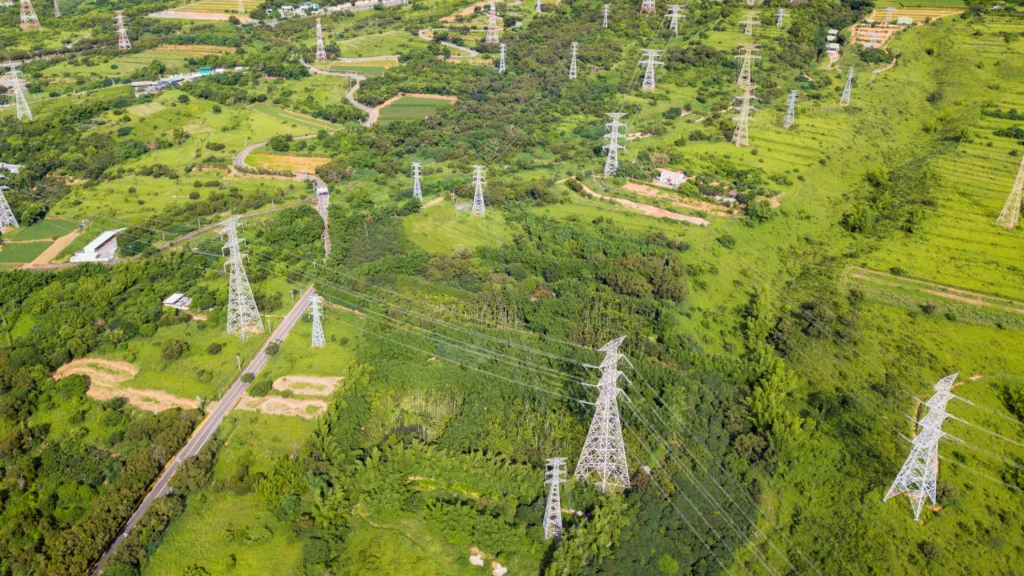
Electricity grids are central to the energy transition and to energy security. They connect dispersed renewable resources to homes, businesses and public services, and they underpin the livelihoods and economies that rely on reliable power. Over the coming decades, very large sums will be invested in grid infrastructure around the world. These developments are not only questions of engineering and finance. Grid expansion takes place within living socio-ecological systems, shaped by soils, vegetation, wildlife, cultural values and community relationships with place.
Whenever new transmission or distribution lines are planned, built or upgraded, they influence how people experience their landscapes and how ecological communities function. Impact assessment, therefore, needs to work on three linked levels:
- Integrated planning that makes efficient use of resources and supports the connection of growing electricity demand at the project and regional scales.
- Ecological effects on biodiversity and ecosystem health.
- Cultural effects on how communities understand, value and interact with their local environment.
Within GINGR, the Linear Infrastructure Technical Working Group (LITWG) is exploring how an emerging GINGR Framework can address these ecological and cultural dimensions of grid planning, construction, operation and decommissioning, and how future projects can contribute to Nature- and People-Positive grids and renewables.

Pressures, impacts and responses
Grid infrastructure creates pressures at every stage of its lifecycle. These pressures fall into two broad categories that interact over time.
Physical pressures include soil disturbance, vegetation clearing, changes in hydrological processes and the creation of corridors through previously intact areas. Earthworks, tower foundations, access tracks and laydown areas can alter water flows and soil structure, which in turn influence vegetation patterns and erosion.
Biological pressures influence species and ecological interactions. They include habitat loss and fragmentation, altered predator and prey dynamics, edge effects, changes in microclimate, increased access for people and vehicles, noise, electromagnetic fields and shifts in species behaviour. Large birds of prey may face collision and electrocution risks. Mammals may change their movement routes. Amphibians and reptiles may be affected by drainage and shading patterns. Pollinators may lose key foraging or nesting resources.
These pressures can also affect local livelihoods, cultural knowledge and the non-material benefits people derive from ecosystems, such as recreation, a sense of belonging, aesthetic qualities and educational opportunities. For many communities, power lines and substations are built into landscapes that hold stories, spiritual significance and traditional resource use.
A wide range of responses is available to address these pressures, from design choices that avoid sensitive areas through to long-term management. Nature-Based Solutions and Ecosystem-Based Solutions form part of this toolbox, alongside more conventional engineering and regulatory approaches. Examples include habitat restoration along corridors, wildlife-friendly tower and line design, riparian planting to stabilise soils and improve water quality, and Integrated Vegetation Management that favours native species over repeated clearance. When these measures are planned with local communities, they can also strengthen cultural ties to the land and support sustainable livelihoods.
The Linear Infrastructure Technical Working Group is assembling evidence on how these different responses interact with ecological and cultural metrics, and how the GINGR Framework can reflect these linkages.

Metrics for biodiversity gains and cultural values
Responsible grid development depends on planning processes that bring together developers, regulators, scientists, local communities and indigenous peoples. Metrics should not appear as technical additions at the end of a project. They belong at the start, forming part of an evidence base for Nature- and People-Positive decisions.
Robust measurement requires data from several sources. These include field surveys, ecological sampling, wildlife mortality monitoring, participatory mapping with communities and remotely sensed information. The use of multiple forms of evidence should align with global frameworks such as the IUCN Red List, the Nature Positive Initiative and guidance from UNEP WCMC, while remaining sensitive to local ecological variation and community worldviews.
Early work by the Linear Infrastructure Technical Working Group (LITWG) highlights the value of a multi-metric, multi-taxa approach. Habitat condition indicators are combined with data from at least four major biological groups: birds, mammals, amphibians and reptiles, and insects or pollinators. This avoids the problems that arise when assessments rely on a single dataset. For example, global occurrence datasets such as GBIF can contain limited or uneven insect data, which restricts their usefulness as the sole basis for biodiversity measurement.
Bioindicators have particular importance. Species such as owls, certain butterflies, medicinal plants or culturally significant trees have ecological roles that link directly to wider ecosystem function, such as pest control, pollination, seed dispersal or soil stabilisation. They may also hold cultural significance through stories, ritual practices, traditional medicine or local identity. This dual role helps integrate ecological and cultural dimensions within a shared analytical space and informs how the GINGR Framework will treat indicator selection.

Cultural values can be documented through participatory workshops, mapping exercises and community-based valuation methods that explore sense of place, heritage, customary law and ecosystem services. This includes values associated with sacred sites, traditional gathering areas, historic routes, or particular species that feature in songs or oral histories.
Spatial integration of ecological and cultural datasets helps avoid silos. Through geospatial interoperability standards such as those developed by the OGC, the emerging GINGR Framework is being designed to operate at site, regional and national scales and to support consistent biodiversity and socio-cultural reporting for grids and renewables.
Unlike carbon, biodiversity does not have a single universal unit of measurement. Work across the scientific and conservation community is converging on the need for a standardised unit of biodiversity gain. One widely supported approach considers a one per cent improvement in the median value across a basket of species groups as the basic unit of gain. The species groups in the basket reflect different taxa and functional roles, rather than focusing on a single indicator.
This approach supports genuine ecological improvement rather than a shift in pressure from one group to another. It allows comparison across projects and regions, while remaining conservative and auditable. Methodologies developed by organisations such as the Wallacea Trust illustrate how such units of gain can be defined and applied in practice. The LITWG is drawing on these experiences as it explores how a biodiversity unit of gain can be incorporated into the GINGR Framework for linear infrastructure.
No single metric can capture all aspects of ecological change, but each contributes useful information when applied as part of a broader multi-metric set.
- STAR scores can be less sensitive in areas with few formally recognised threatened species. Their value improves when institutions jointly update threat assessments through frequent field data collection, sometimes referred to as Calibrated STAR.
- Mean Species Abundance (MSA) can perform inconsistently across scales and may distort outputs when datasets of different resolutions are combined without care.
- Potentially Disappeared Fraction of species (PDF) focuses on local extinction risks but becomes more informative when linked to global extinction probabilities and indicators of ecosystem productivity.
- Reinforcement learning tools such as CAPTAIN can integrate several metrics while balancing conservation outcomes against financial and operational constraints, and can help identify priority areas for habitat restoration, Nature-Based Solutions, Ecosystem-Based Solutions and other conservation actions.
Recognising the strengths and limitations of each metric supports more reliable and transparent decision-making. The GINGR Framework is being developed to work with combinations of metrics that are auditable, conservative and sensitive to both local conditions and broader policy targets.

Governance, justice and the emerging GINGR Framework
Measurement on its own is not sufficient. Decisions about grid expansion also raise questions about rights, equity and procedural fairness. The Linear Infrastructure Technical Working Group (LITWG) is therefore grounding the GINGR Framework in a claims-aware approach in which outcome statements must be supported by evidence and in which social and cultural rights are central to the assessment process.
Free, Prior and Informed Consent, indigenous law and local knowledge systems are treated as valid forms of evidence alongside ecological data. This places recognition justice at the centre of grid planning. It also helps ensure that the energy transition proceeds in ways that communities consider fair, and that the benefits and burdens of new infrastructure are shared in an equitable manner.
As part of this work, the LITWG is developing a matrix for linear infrastructure as a core analytical tool within the GINGR Framework. The matrix is being designed to categorise pressures, align them with relevant metrics and identify suitable validation methods. It brings together data from field surveys, bioindicators and participatory approaches to establish baselines for long-term monitoring and adaptive management. It follows the mitigation hierarchy, from avoidance and minimisation through to restoration and offsetting, and can be applied alongside Integrated Vegetation Management, Nature-Based Solutions and Ecosystem-Based Solutions in and around grid corridors where appropriate.
The intention is that the matrix will do more than list impacts. It will operationalise the GINGR Framework for grids and other linear infrastructure by providing a shared platform where different perspectives and disciplinary approaches can be compared openly. It will support multi-metric pathways that allow biodiversity gains to be expressed in comparable units, while also making cultural impacts visible and measurable. In this way, the GINGR Framework, with the matrix at its core, is being developed as a reference point for grid and renewable energy planning that is ecologically sound, culturally legitimate and aligned with Nature- and People-Positive outcomes and global commitments on conservation and restoration.
As countries expand and modernise their electricity grids, the need for approaches that combine scientific rigour with cultural understanding will increase. The work of the LITWG on the GINGR Framework offers an emerging way to measure, compare and improve ecological and cultural outcomes across grid projects. By integrating diverse forms of evidence and creating clear pathways for measurable biodiversity gains and cultural recognition, it seeks to support an energy transition that is both reliable and respectful of the places and communities it affects.
For more information or to become involved in the work of the Linear Infrastructure Technical Working Group, please contact:

Adrián Maté Environmental Coordinator – GINGR adrian@renewables-grid.eu