
offshore metrics
Advancing Nature-Positive contributions in offshore wind
A collaboration between IUCN, the Renewables Grid Initiative and Bluedot Associates Ltd to support offshore wind projects in delivering measurable Nature-Positive contributions at the site level
IUCN and the Renewables Grid Initiative (RGI) are supporting the offshore renewables sector to implement high-integrity Nature-Positive contributions aligned with the Kunming-Montreal Global Biodiversity Framework (KM-GBF). This sets out ambitious 2030 targets for the conservation of biodiversity, including for species and ecosystems, as well as a vision and a mission aligned with the global, societal Nature-Positive goal, defined by the Nature Positive Initiative as to “halt and reverse nature loss by 2030 on a 2020 baseline, and achieve full recovery by 2050”.
In recognition of the valuable contributions that the renewable energy sector can deliver towards the KM-GBF and Nature-Positive, IUCN and RGI have established the collaborative Global Initiative for Nature, Grids and Renewables (GINGR) initiative. Its key goal is to accelerate a Nature-Positive and people-positive energy transition.
As part of the GINGR initiative, IUCN is leading a workstream to support the delivery of measurable contributions to these global goals by offshore wind projects. As part of this workstream, a collaboration between IUCN, RGI and Bluedot Associates Ltd is seeking to support offshore wind projects to achieve measurable Nature-Positive contributions at the site level through the development of an Offshore Wind Nature-Positive Contributions Framework.




context
Context behind the collaboration and key challenges at sea
The purpose of this collaboration is to support offshore wind projects to understand and overcome key challenges and perceived barriers to delivering Nature-Positive contributions in the marine environment.
To achieve high-integrity contributions to Nature-Positive, offshore wind projects need to understand how to operationalise effective approaches at the site level. This includes a need for offshore wind projects to go beyond “impact reduction” and bring measurable and sustainable improvements to the state of nature, integrating the benefits of diverse values of nature to people. This requires promoting robust outcomes with measurable net results for biodiversity, notably through improving the health, abundance, diversity, integrity and resilience of species and ecosystems that help maintain natural processes.
CHALLENGES
Framing and measuring loss
For projects, practical challenges include understanding how to frame and measure loss associated with site-level development impacts; and understanding the scope and scale of positive actions needed to achieve measurable outcomes.
Complexity of the marine environment
In the marine environment, challenges can be heightened due to challenges with measurement, data availability, dynamism and variable interconnected spatial and temporal scales, which often afford greater complexity in comparison to operations on land.
Selecting appropriate metrics
Challenges also exist in the application and selection of appropriate metrics at the site level that help to underpin losses and any net gains from positive actions, and how to relate these to the emerging consensus around metrics intended to measure Nature-Positive outcomes.
framework
Offshore Wind Nature-Positive Contributions Framework
Supporting offshore wind projects to deliver measurable Nature-Positive contributions at the site level by offering guidance that is needed to:
 01
01Frame
Align with key concepts that support the achievement of measurable Nature-Positive contributions.
 02
02Assess
Define losses and gains in a meaningful and measurable way in the context of Nature-Positive outcomes.
 03
03Measure
Select, prioritise and apply metrics that measure Nature-Positive contributions.
 04
04Define
Determine the scope and scale of actions and outcomes that deliver Nature-Positive contributions.
 05
05Deliver
Understand how to operationalise and implement approaches that deliver Nature-Positive contributions.
Every component on the right is a link — select one to access the content of each component.
Framework PNG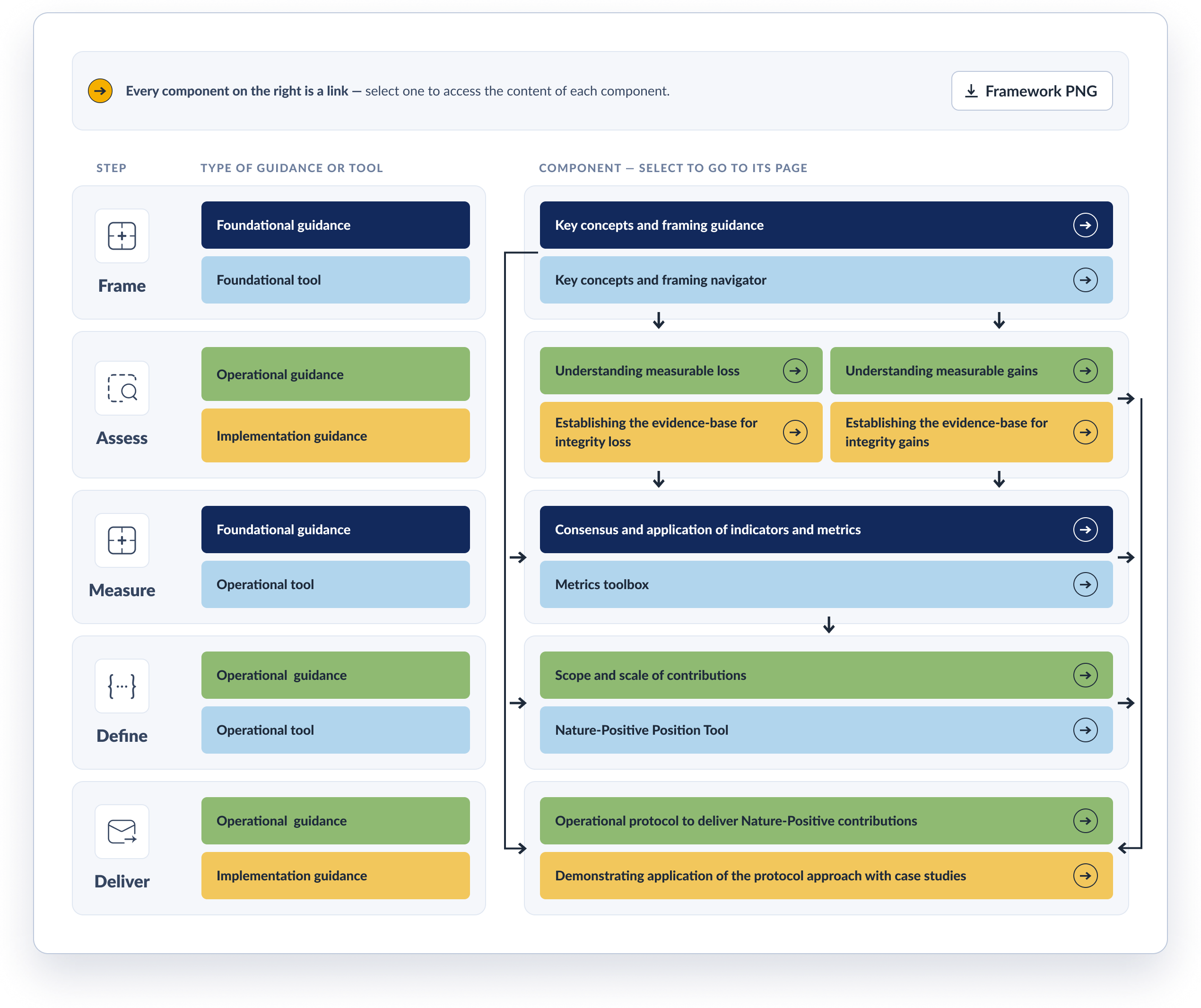
 Frame
Frame Assess
 Measure
 Define
 Deliver
All content of the framework on one page
Access every component’s guidance, tools, and PDFs in a single reference page.
navigator
Key Concepts and Framing Navigator
Within the Offshore Wind Nature-Positive Contributions Framework, key concepts and framing are established to provide underpinning and integrated guidance to support the delivery of measurable Nature-Positive contributions by offshore wind projects. A navigator is provided below.
FrameThe key concepts and framing guidance underpins approaches that offshore wind projects can take to deliver measurable Nature-Positive contributions
Pressures
A fixed baseline reference state underpins understanding of measurable loss and gains.
Project impacts determine the potential for measurable loss and the approach to achieve measurable gains.
Understanding the drivers of biodiversity loss across seascapes informs the assessment of project impacts and helps target actions that can deliver measurable gains.
Actions that deliver measurable gains need to take account of state, pressures and the scope and scale of outcomes.
Seascape approach:
Applying a seascape approach supports measurable outcomes through informing understanding of baseline state, pressures and the context for positive actions at ecologically appropriate scales.
Integrity-led approach:
An integrity-led approach frames the baseline reference state and underpins understanding of when measurable loss and measurable gains occur.
Priority-led approach:
Actions to address loss and achieve gains are informed by consideration of priorities relating to state, compliance requirements and stakeholder views. Defining priorities relating to integrity informs where measurable loss and gains are possible.
Establish understanding of baseline integrity state for habitats and species using ecologically appropriate scales of analysis, applying a pragmatic, precautionary and proportionate approach embedding expert opinion. Establish priorities relating to integrity of defined biodiversity values, compliance requirements and stakeholder views, which informs the understanding of where measurable loss is possible and the actions that can be taken to deliver measurable integrity gains.
State prioritisation supports understanding of where measurable integrity loss is most likely. For these priorities, define potential project-related impacts on integrity using an ecologically appropriate scale of context. Use conclusions on integrity loss to determine the requirements and approach for actions that deliver measurable integrity gains, i.e., whether offsets are needed or gains can be delivered using other measurable conservation actions.
State prioritisation identifies the biodiversity features subject to integrity loss. Using this framing, the type and location of drivers causing significant integrity loss for state priorities can be determined using an appropriate ecological scale of analysis. Consider the ability for a project to exert control and influence to reduce these pressures. Define the type and location of feasible actions that can be taken to address pressures causing integrity loss or to restore integrity to deliver measurable integrity gains.
Define flexible restoration and/or pressure reduction actions that can lead to measurable on-the-ground integrity gains using the prioritisation embedded in the analysis of state and pressures, informed by an ecologically appropriate scale of analysis and expert opinion. Promote actions that offer scalable, additional, equitable, people-positive and long-lasting outcomes aligned with existing conservation goals and initiatives. Define the appropriate approach to provide the evidence base for outcomes.
AssessHow impacts may lead to measurable loss of integrity, and how to target actions that deliver measurable gains.
MeasureEstablishing the evidence base for measurable outcomes using quantitative indicators and metrics.
DefineThe scope and scale of contributions across a continuum of measurable outcomes.
DeliverAn operational protocol, demonstrated through case study application.